Why using Moissanite on a Watch?
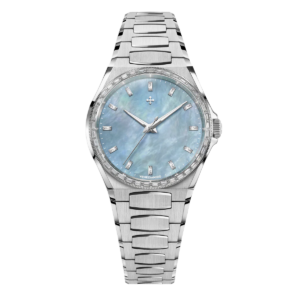
Moissanite is a viable choice for a decorated watch. With a hardness of 9.25 on the Mohs scale — exceeding even sapphire crystal — it resists scratching, maintains its clarity indefinitely, and delivers consistent optical performance over years of daily wear. The material holds up. That question is settled.
What is less commonly explained is why moissanite looks the way it does — and under which conditions it performs best.
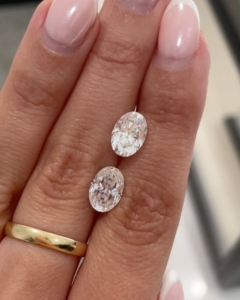
The stone is doubly refractive, meaning light entering it separates into two distinct rays. This produces a dispersion rating of 0.104, compared to diamond’s 0.044 — more than double. The visible consequence is an intense play of colour and fire that exceeds what a natural diamond of equivalent size produces. In direct sunlight, outdoors, under natural daylight, this property is fully on display. In warm artificial light indoors, the gap narrows significantly.
This makes moissanite a stone that rewards outdoor contexts. Not a limitation — a characteristic. Choosing moissanite for a watch worn primarily outside, in natural light, is a technically informed decision that maximises what the material does best. It is not a substitute for diamond. It is a different specification.
Where quality differentiation actually lives in decorated watches, however, is not in the stone. It is in the setting.
Any stone — moissanite, diamond, sapphire, ruby — placed in a poorly executed setting will eventually work loose under the mechanical stresses of daily wear. Micro-vibrations, impacts, temperature variation: these affect the metalwork, not the stone. A well-constructed bezel setting retains almost any stone indefinitely. A poorly executed pavé loses stones regardless of what they are made of or what they cost.
Moissanite accepts the same setting techniques as any other hard stone. Bezel, pavé, channel, bead — the full range of decorative watchmaking applications is available, with no material-specific constraints. It is worked by skilled setters exactly as diamond or sapphire would be.
Before purchasing a moissanite-decorated watch, the relevant question is not whether the stone is adequate. It is whether the person who set it knew what they were doing — and what recourse exists if a stone is lost.
The stone is the easy part. The setting is where the watch is made or broken.