Are Timex watches really tough?
The honest answer varies completely depending on which era of Timex you are discussing.
The early Timex — the iconic machine designed around the “takes a licking and keeps on ticking” premise — was built on a philosophy entirely alienated from traditional horology. While Swiss manufacturers were developing increasingly complex shock-protection systems to guard delicate balance staff pivots, Timex eliminated the vulnerability at its source by redesigning the architecture.
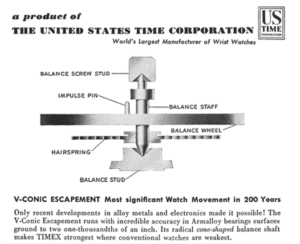
Their movements relied on conical pivots operating directly within the mainplate without jewel bearings. A conical pivot disperses impact energy along its entire tapered surface rather than focusing stress onto a fragile point. It accelerated tool wear during production, introduced additional friction, and sacrificed fine chronometric accuracy — but it was virtually unbreakable. You could drop it, subject it to severe impacts, or strap it to an outboard motor on live television, and it would continue to beat.
The trade-off was precision and serviceability. Movements from that period were notoriously difficult, if not practical impossibilities, to overhaul: tolerances were tight, parts were proprietary, and few watchmakers were willing to bench them. In most cases, when an old Timex stopped, the entire caliber was swapped out rather than repaired. Yet, it took decades for them to reach that point. The synergy of conical pivots, a simplified wheel train, and a durability-first engineering approach produced calibers capable of running in environments that would destroy far more refined movements.
That Timex lasted because it was explicitly engineered for pure survival. Not for splitting seconds, not for ease of maintenance, and certainly not to look refined under a loupe. Its sole objective was to keep running — anywhere, and for as long as possible.
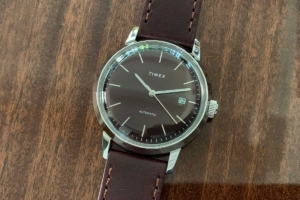
Today’s Timex is an entirely different artifact. Following multiple corporate shifts, current production utilizes movements sourced from the same global supply chains powering every other entry-level brand — standard quartz oscillators, off-the-shelf electronic modules, and mass-produced mechanical calibers. They endure as long as any other watch in their price bracket: reliably enough, until they fail, at which point a total replacement is vastly more economical than a repair.
The radical engineering ethos that defined the original Timex is absent from the modern product. What persists is the brand name, the marketing legacy, and an accessible price point tailored for mass retail.
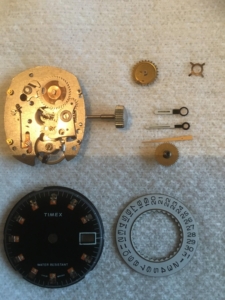
An original Timex movement retrieved from a scrap lot — battered, oxidized, and worn — still ticks once wound. Mission accomplished.
If you own a vintage Timex housing its original caliber, you hold a peculiar piece of industrial design: a mechanical solution engineered for a specific problem in a way no other manufacturer attempted. It will likely continue running, with its signature, endearing inaccuracy, long after far more prestigious watches of the same era require a full service.
If you purchase a Timex today, you are acquiring a sensible entry-level timepiece that will perform on par with its peers.
The label on the dial remains unchanged. The mechanical substance and philosophy behind it do not.