Round vs Rectangular: what are the differences?
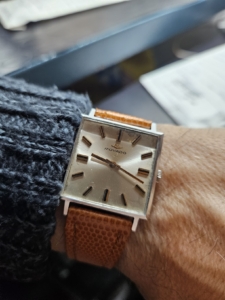
At first glance, the choice between a round and a rectangular watch case looks like a matter of personal taste. It is something more precise than that.
Geometry has consequences on the wrist. A rectangular case aligns with the natural lines of the arm — the straight edges follow the wrist’s own geometry rather than working against it. The result is a watch that fills its space more efficiently than a circle, which by definition creates voids where the curves meet the skin. On a narrower wrist this effect is amplified: a well-proportioned rectangular case can read as more resolved, more deliberate, more fitted to the context than a round watch of equivalent diameter.
This is the functional argument. The more compelling one is perceptual.
The human brain expects a watch to be round. The association runs deep — centuries of pocket watches, tower clocks, wall clocks, and wristwatches have made the circular dial one of the most stable visual conventions in material culture. When a rectangular case appears on the wrist, something in the visual processing registers mild surprise. Not confusion — just a fraction of a second of heightened attention, the kind that any object produces when it departs from expectation in a coherent and intentional way.
That fraction of a second matters. In an environment where most watches are round and most round watches read as broadly similar from a distance, a rectangular case achieves differentiation at the most fundamental perceptual level — before the brand, before the complications, before any conscious evaluation of the object. It is simply noticed first.
Cartier built an entire design identity on this principle. The Santos in 1904, the Tank in 1917, the Baignoire as an elliptical variation — each a distinct geometric proposition, each immediately recognisable across a room without requiring a logo or a brand name to do the work. The rectangular case was never an eccentricity or a historical accident. It was a precise strategic choice that transformed a formal departure from convention into a lasting perceptual advantage.
The round watch is the default. Defaults are comfortable, familiar, and reassuring. They are also, in a crowded market, effectively invisible.
A rectangular watch asks to be looked at. That is not a small thing.