How good are Titan watches?
Titan: The Watch Manufacturer Nobody Outside India Is Talking About — Yet
There is a question worth asking about the global watch industry: how does a manufacturer become the fifth largest in the world by volume, develop genuinely sophisticated in-house movements, enter the most prestigious watch awards on the planet — and remain almost entirely invisible to Western collectors?
The answer, in Titan’s case, is geography and narrative. The engineering has been there for longer than most people realise.
What Titan actually is
Titan Company was established in 1984 as a joint venture between the Tata Group and the Tamil Nadu Industrial Development Corporation, with manufacturing operations headquartered in Hosur, Tamil Nadu. What began as a quartz watch manufacturer for the Indian domestic market has grown into a vertically integrated operation producing across five locations, with a retail presence spanning over 2,000 points of sale in India and distribution across the Middle East, Southeast Asia, and North America.
The scale is industrial. The ambition, increasingly, is not.
The mechanical programme: a decade of quiet development
Titan’s serious engagement with mechanical watchmaking began in 2015, when the brand developed its first 12-line calibre beating at 4Hz — a 2824-style architecture built initially in technical collaboration with France Ebauches, with progressive internalisation of manufacturing over the following years. What started as a USD 12 million investment in movement development has expanded into a comprehensive in-house complications programme.
The Edge collection established the technical baseline. The quartz Edge launched in 2002 as the world’s thinnest water-resistant quartz watch — Calibre T9081, movement thickness 1.15mm, total case height 3.5mm. The mechanical Edge followed in 2021: Calibre Edge 903, hand-wound, 2.2mm thick, 18 jewels, 28,800 vph, 42-hour power reserve, 106 components almost entirely manufactured in India. Total case height 5.85-6mm depending on configuration. Price at launch: approximately USD 2,300.
The current Edge Ultraslim Mechanical, released in 2026, carries the same Calibre Edge 903 in a grade 2 titanium case at 5.7mm total — the movement openworked, bridges decorated with Geneva waves, wheels sunray-finished, components rhodium-plated. Limited to 50 pieces. Price: approximately USD 3,300. Entered at the GPHG 2026 in the Essential category, competing against Parmigiani, MB&F, IWC, and Audemars Piguet.
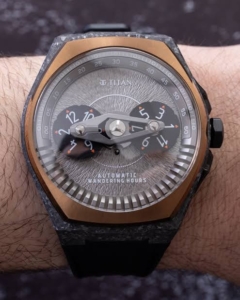
The Stellar collection brought a different kind of complication: India’s first fully in-house wandering hours, powered by Calibre 7AW-D2 — automatic, 22 jewels, 28,800 vph, 40-hour power reserve. The case: crystallised titanium. The complication: rotating discs that place the hour in an aperture as it passes, one of the most visually distinctive time displays in mechanical watchmaking.
The tourbillon: where the statement was made
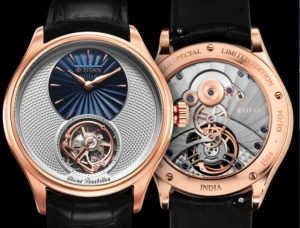
The milestone that changed the conversation arrived in 2024, for Titan’s 40th anniversary. India’s first in-house flying tourbillon — Calibre 7TH1, hand-wound, 141 parts, 4Hz, 36-hour power reserve, hand-decorated with Perlage, Côte de Genève, Spiral Satin, and Circular Satin. The tourbillon bridge is shaped as a T — Titan’s initial — which also functions as the petite seconds hand. The dial carries two handcrafted guilloché patterns: peacock blue flinqué sub-dial, rice grain outer ring, executed by master artisans in Switzerland. Case: 44mm, 18-karat rose gold. Limited to four pieces. Price: approximately USD 31,000.
The piece was entered at the Grand Prix d’Horlogerie de Genève 2024.
In 2025 the movement returned as the Nebula Jalsa — Calibre 7TH2, 28,800 vph, 36-hour power reserve, 144 parts, bridges set with red agate stone, dial hand-painted by Padma Shri Shakir Ali, a Mughal and Persian miniature painting specialist. Limited to 10 pieces. Price: approximately USD 45,200.
The value question
At the accessible end of the range — the Zero Hour Professional Diver 500M, titanium case, in-house automatic, rated to 500 metres, priced at USD 840 — no Swiss manufacturer produces a comparable specification at anywhere near this price point. The engineering relative to cost has no European equivalent.
At the haute horlogerie end, the calculus is different. The technical achievements are genuine and documented. The movement development programmes are real, multi-year industrial investments. What Titan does not yet carry — and has not claimed — is the cultural weight that Swiss brands have accumulated over two centuries. Resale value, collector community, secondary market depth: these take generations to build. Titan is forty-two years old.
The engineering story is not a substitute for legacy. It is also, increasingly, not nothing.
What comes next
In April 2026, Titan’s CEO announced a new brand — conceived as the most advanced expression of the company’s watchmaking capabilities — to launch in the second half of 2026, positioned up to CHF 50,000. The name has not been disclosed. The ambition is explicit.
For a buyer who evaluates an object by what it does rather than what it implies, Titan at any price point is a serious proposition. For a buyer who needs the cultural address, the Swiss postcode still matters.
Both positions are defensible. The one that is becoming harder to defend, with each GPHG nomination, is the position that serious watchmaking has a fixed geography.