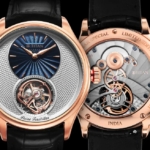
Why wearing a watch over the shirt? Gianni Agnelli and his Watches, the art of breaking rules

There are men who wear watches. There are men who collect watches. And then there was Gianni Agnelli — who did both, in ways that nobody had thought to try before and most people have failed to replicate since.
L’Avvocato — grandson of Fiat founder Giovanni Agnelli, controlling shareholder of one of the largest industrial empires in postwar Europe, owner of Juventus, regular presence on every best-dressed list ever compiled — was not a watch collector in the conventional sense. He was something more interesting: a man who wore objects of extraordinary technical and financial significance with the same casual authority he brought to everything else.
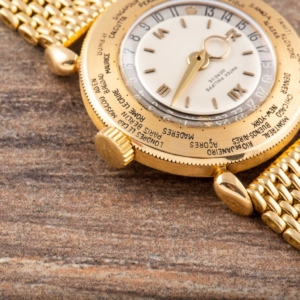
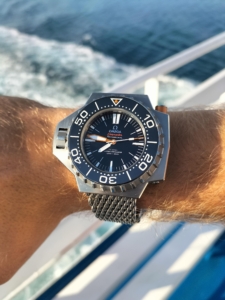
The watches were serious. The Patek Philippe World Time ref. 1415HU — yellow gold case, manual movement, rotating disc simultaneously displaying the time in 41 cities — was not a purchase. It was a statement of cosmopolitan identity worn on the wrist. Current auction estimates sit around €83,000, with the rarest documented examples reaching €6.6 million. The Omega Seamaster PloProf — a professional dive instrument of considerable size, designed for saturation diving — appeared on his wrist with a suit, because why not. The Audemars Piguet perpetual calendar ref. 5555BA in yellow gold, 36mm, a grand complication worn without ceremony. A Vacheron Constantin pocket watch inherited from his father, converted to a wristwatch and worn as frequently as anything else in the collection. A Hamilton Pulsar P2 — one of the first LED digital watches ever produced, priced at USD 395 at launch, which at the time was USD 10 more than a Rolex Submariner. And a Casio, worn with the same authority as the Patek.
The eclecticism was deliberate. Agnelli was not performing taste — he was expressing it, and his taste had no interest in the hierarchies that the watch industry uses to organise itself. An object was either interesting or it wasn’t. Price and prestige were irrelevant variables.
The gesture for which he remains most photographed and most discussed is the over-cuff position: watch worn over the shirt sleeve, often directly over the cufflink. The origin is disputed. His Italian shirtmakers cut cuffs so close to the wrist that a watch would not fit underneath — that is one documented explanation. He disliked metal against bare skin — that is another. His friend and contemporary Taki Theodoracopulos suggested the habit began as a practical solution before it became a signature. The poet Jean Cocteau had worn watches over his cuffs after World War I, in homage to soldiers returning from the trenches. Agnelli may or may not have known this. It is the kind of detail he would have appreciated either way.
What is not disputed is the result. A gesture that should read as careless — technically incorrect, visually unconventional, the kind of thing that in lesser hands produces the impression of someone who got dressed without a mirror — became, on Agnelli’s wrist, the most studied watch-wearing position in the history of men’s style. Thousands of men have attempted to replicate it. Most of them look like they got dressed in the wrong order.
The reason the original worked and most copies don’t is not complicated. Agnelli understood every rule he was breaking. The authority behind the transgression was total and unambiguous — it came from decades of immaculate sartorial judgment, from bespoke tailoring by A. Caraceni in Milan, from a natural physical presence that Diane von Fürstenberg described simply as: every woman in the world was in love with him and every man wanted to be him. Against that background, a watch worn over a cuff reads as nonchalance. Against any lesser background, it reads as an oversight.
The lesson that Agnelli’s watch collection actually teaches has nothing to do with specific references or price points. It is about the relationship between knowledge and freedom. He could wear a Casio next to a Patek because he understood what both objects were. He could wear a dive watch with a suit because he understood what both the watch and the suit were for. He could wear anything over a cufflink because he had earned, through decades of consistent judgment, the authority to decide what the rules meant.
You cannot borrow that authority. You can only build it.